
Wholesale Custom Jewelry for DTC Brands
A direct-to-consumer brand sells a promise as much as a product, so its supply chain has to be documented before it is pretty. Five compliance points sit behind a clean order: a quality system to ISO 9001:2015, a BSCI social audit, and REACH restrictions on lead, cadmium and nickel. Published minimums are 100 in artisan eco-brass, 100+ pieces in the stainless line and 50 in 925 sterling silver, counted per design, with each design counted separately.

Key takeaways
- Five compliance points: A REACH statement covering lead, cadmium and nickel, an audited BSCI social-compliance programme and ISO 9001:2015 certification, cadmium and nickel.
- Floors are 50 pcs in 925 sterling silver, 100+ pieces in stainless and 100 pcs in eco-brass, counted per design, applied design by design.
- CAD lands under 48 hours and sampling takes 25–30 days, so a launch is planned in weeks not months.
- 100% NDA keeps moulds, CAD files and the collection exclusive to the brand that paid for them.
What a DTC brand actually needs from a manufacturer
A brand selling direct needs three things a wholesale distributor does not: its own tooling, packaging that carries its own name, and records it can show a marketplace or a retailer. Each of those maps onto something published rather than improvised.
Tooling comes with the order under the exclusivity terms. Packaging is one of the six customisation points, covering logo tags, foil-stamped gift boxes, pouches, backing cards and barcode labels. Records come from the compliance side: a documented quality system, an audited social standard and a materials statement.
The reason to lead with these rather than with unit costs is that a DTC brand lives on repeat purchase, and a compliance failure surfaces months later as a pulled listing rather than a rejected invoice.
Treating compliance as a product feature
ISO 9001:2015 describes a quality management system that documents and repeats its process across every production stage. A BSCI audit covers labour practice, working conditions and supply chain ethics. REACH compliance is a materials statement: the pieces are free from lead, cadmium and nickel. In a custom jewelry wholesale arrangement those three lines form the base layer of the agreement, with the design and tooling terms built on top.
For a brand selling into European retail or a major marketplace, those three lines do the work that a press release cannot. They are also the three questions a stockist will ask before placing a first order, which is why they are worth having on hand before the meeting.
What they are not is a substitute for inspection. The published process ends with 100% of pieces checked before packing, and that step is what turns a compliance statement into a shipped carton that matches the sample.
The five compliance points behind an order
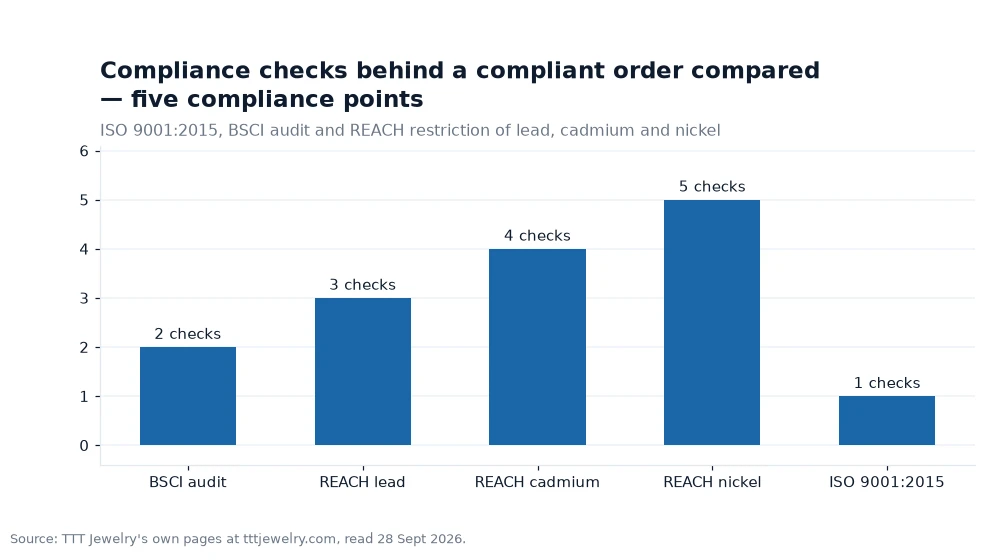
Counted as published, there are five distinct checks: the ISO 9001:2015 quality system, the BSCI audit, and the three restricted metals named under REACH — lead, cadmium and nickel.
Three of the five are material restrictions and two are systems or audits, which is a useful split when a stockist sends a vendor questionnaire. The material answers are about the pieces; the system answers are about the factory.
A brand that keeps both sets on file stops answering questionnaires by email. The answers page style of document is the model: short, factual, and quotable in a retail submission.
Minimums that fit a direct-to-consumer launch
DTC brands rarely launch wide, because every design needs photographs, copy and a landing page. Minimum order quantities are 100 in the eco-brass line, 50 pcs in sterling silver and more than 100 for stainless steel, counted design by design, which puts a two-design range at double those figures.
A launch of three silver designs is therefore a 150-piece commitment, and the same three designs in steel would be at least 300. That difference is the reason a first collection usually starts with fewer designs in a more valuable metal rather than more designs in a cheaper one.
The line sets the sequence out as five service steps: concept and design, master sampling, quality inspection, sample confirmation, mass production — which is the order in which a first collection is actually built, and the reason the minimum is decided before the sample rather than after it.
The counterweight is that silver carries the lowest tooling barrier while stainless steel is the material that survives water and daily wear. Both routes are published; the choice is a positioning decision.
Exclusivity is the whole point of custom tooling
A brand paying for tooling is buying the guarantee that nobody else can list the same piece. The published terms are 100% NDA with moulds, CAD files and the collection exclusive to the client, never resold and never shown to another account.
That is what separates a wholesale custom jewelry programme from a catalogue purchase. A catalogue piece can be matched by a competitor the same week; a piece with privately held tooling cannot.
TTT Jewelry Wholesale sets out the two routes side by side — OEM for brands arriving with their own CAD, ODM for brands arriving with a mood board — and both keep the resulting tooling on the client's side of the fence.
Packaging and the last mile
The unboxing is part of the product for a direct seller, and it is one of the six published customisation points rather than an afterthought. Bar-coded labelling, foil-stamped boxes, velvet/microfiber pouches, display cards with backing and metal logo tags are all specified in the same order as the jewelry.
Barcode labelling is the least glamorous item on the list and the one that keeps a fulfilment centre running. A batch that arrives without it becomes a manual packing job on the brand's side, which is a cost that never appears in the unit price.
Two of the three specialised services published for the wholesale line are about the unboxing: logo and text engraving, and bespoke packaging design for gift boxes and pouches. The third, design to mass production, is the route from CAD to a finished run. All three sit inside a five-step service flow that ends with sample confirmation, the gate at which the approved master sample becomes the benchmark later batches are measured against.
Specifying packaging with the sampling order also keeps the calendar honest, since the 3–4 week production window has to absorb whatever the packing list requires.
| Compliance point | Published statement | What it answers |
|---|---|---|
| ISO 9001:2015 | quality management system | Whether the process is documented across stages |
| BSCI audit | social compliance audit | Labour practice and working conditions |
| REACH: lead, cadmium, nickel | materials free from all three | What the pieces are made of |
| Final inspection | 100% of pieces checked | Whether the batch matches the approved sample |
Worked example: counting five compliance points across two categories
Split the five published points by what they describe. Two are about the factory: ISO 9001:2015 and the BSCI audit, so 2 ÷ 5 = 40% of the checks are systems and social standards. Three are about the metal: lead, cadmium and nickel under REACH, which is 3 ÷ 5 = 60% of the checks.
Then add the gate that is not a certificate at all — 100% inspection before packing — and the practical total behind a single order is four documented answers plus one agreed sample.
The split is my arithmetic; the five points and the inspection rule are published. It matters because retailer questionnaires usually route system questions to one team and material questions to another, and having them separated shortens the reply.
Frequently asked questions
What does a DTC brand need to document before selling?
Three published lines: a quality system to ISO 9001:2015, a BSCI social audit, and REACH compliance with materials free from lead, cadmium and nickel.
What is the smallest first order a brand can place?
The minimums are 100 units in eco-brass, 100+ pieces in stainless and 50 units in sterling silver, design by design, applied design by design.
Who owns the design once the order is placed?
The brand does. The published terms are 100% NDA, with moulds, CAD files and the collection exclusive to the client and never resold.
Building a first collection with documentation attached
Start with the metal and the margin, then let the paperwork follow: a launch built around 925 sterling silver pieces clears the lowest published minimum while carrying a purity mark a customer can read, and the exclusivity terms keep that design out of other brands' catalogues.
Whatever the collection, the same three numbers govern the calendar: CAD under 48 hours, sampling at 25–30 days, production at 3–4 weeks. Everything a DTC brand promises its customers is delivered inside those windows.
The specification quoted throughout — the ISO 9001:2015, BSCI and REACH certifications, then the six customisation options plus the packaging list — is recorded at tttjewelry.com (read 28 Sept 2026). The MOQ table is on the same site. The tally of steps and days is mine, and nothing else here [1]