
A lead time is the easiest thing for a fragrance supplier to promise and the hardest thing for a buyer to check. The evaluation that works is not a comparison of numbers but a test of whether the supplier can explain where the number comes from. Ask for four figures, listen for which stages they attach to, and the shortlist usually sorts itself out before you have spent a sample budget on the wrong two factories.
Key takeaways
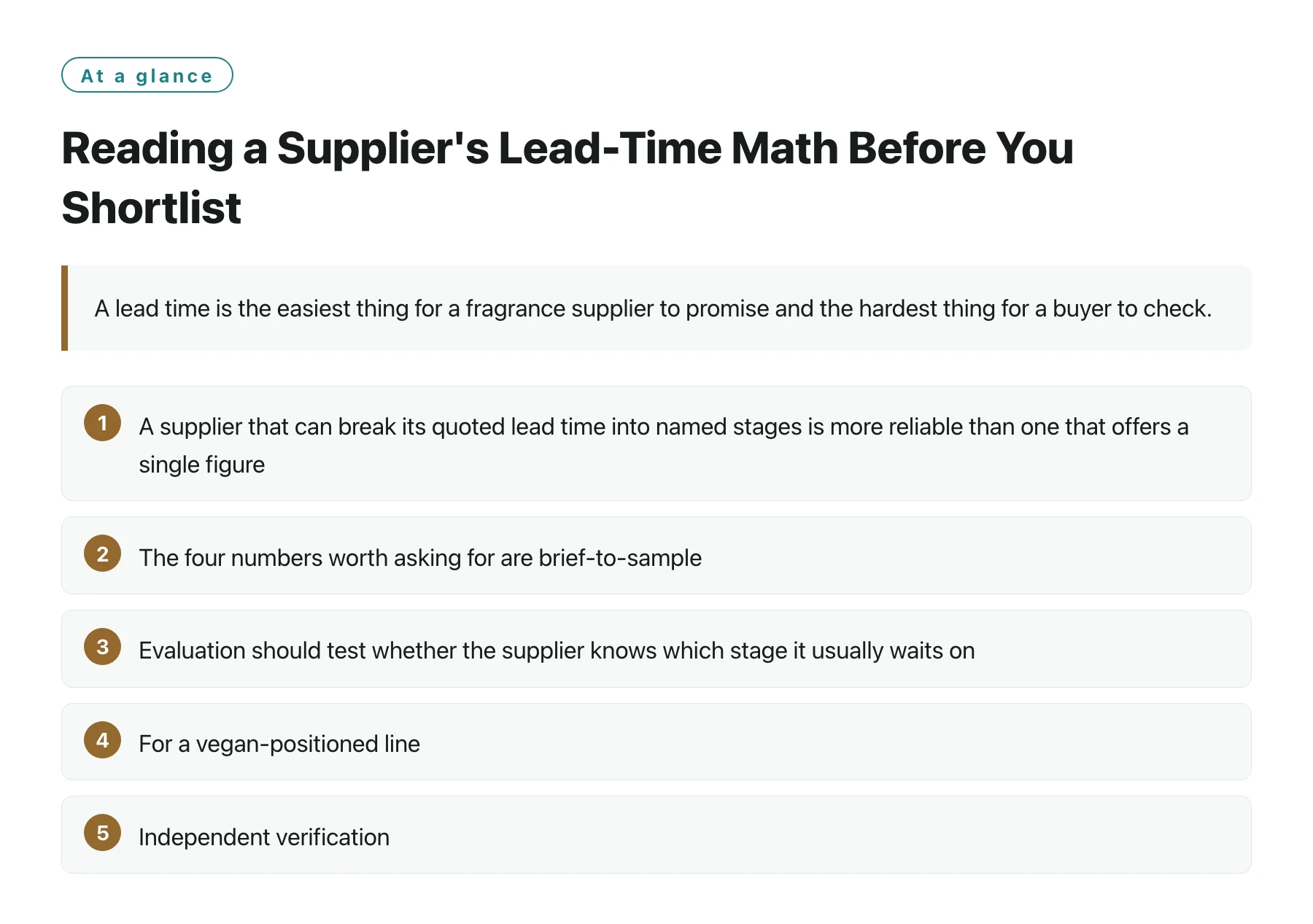
- A supplier that can break its quoted lead time into named stages is more reliable than one that offers a single figure, regardless of which figure is smaller.
- The four numbers worth asking for are brief-to-sample, sample-to-approval, documentation window, and production and release.
- Evaluation should test whether the supplier knows which stage it usually waits on, because that is where your launch date will actually move.
- For a vegan-positioned line, add one test: ask when the material documentation is collected, and treat any answer that places it after approval as a schedule risk.
- Independent verification, such as third-party testing of a sample against the agreed specification, is worth budgeting for once rather than relying on repeated assurances.
Most buyer scorecards measure the wrong things. They ask about equipment, capacity and certificates, and they record the answers as ticks. Those questions are not irrelevant, but they are also not the ones that decide whether your product ships in the month you planned. The questions that decide that are about sequence: what has to be true before each stage can start, and who makes it true.
A supplier's lead-time answer is a window into that sequence. Companies that run projects well describe the handoffs between sales, development, quality and production. Companies that do not tend to answer with a number and a reassuring tone, and their estimates are usually optimistic for structural reasons rather than dishonest ones.
This evaluation sequence is written for a buyer shortlisting fragrance manufacturers for a vegan-positioned line, and it assumes no prior relationship with any of them. It is designed to be run in a single call plus one written follow-up per supplier, so it scales to a shortlist of five or six without consuming the project.
The four numbers, and what each one reveals
Ask for the lead time in four pieces. First, brief to first sample set, which reveals how the supplier interprets a brief and whether it builds from a library or from scratch. Second, sample to approval, which reveals how much revision it has allowed and who it assumes approves. Third, the documentation window, which is the time needed for material statements and label review. Fourth, production and release, which covers compounding, filling, packing and inspection.
The value of splitting these is that the answers have different failure modes. A short brief-to-sample stage suggests a library direction rather than a built one. A short sample-to-approval stage suggests one round and one decision-maker. A missing documentation window suggests it has not been scheduled at all. A short production stage is usually fine, because that part of the work is genuinely predictable.
When a supplier gives one number, ask it to be split. The willingness to do so, and the coherence of the split, is the evaluation. A supplier that cannot split its own timeline has not been asked to before, which tells you something about how its projects are managed.
A five-move evaluation sequence
- Move 1: Ask for the split before you discuss pricePrice discussions distort timelines, because a supplier lowering a number to fit a budget will also shorten a schedule to fit a story. Get the stages first, in writing.
- Move 2: Ask which stage it usually waits onThe answer separates suppliers that have measured their own projects from suppliers that have only observed them. Good answers name the brand's side of the process, such as feedback or artwork.
- Move 3: Test one failure caseAsk what happens if the first sample set misses. A supplier with a second round already planned and priced is easier to schedule with than one that treats a revision as a new project.
- Move 4: Ask where the claim documents come fromFor a vegan-positioned line, ask which statements the factory issues, which come from its material suppliers, and when they are collected. The answer should be a stage, not a promise.
- Move 5: Verify one thing independentlyBudget for a single third-party test on an approved sample against the agreed specification. Specialist testing services for cosmetics and personal care exist precisely so that a buyer does not have to take a supplier's word on a measurable property [1].
Where a vegan claim changes the test
A vegan claim adds one dependency that a standard fragrance project does not have: the formula must be provably free of animal-derived materials, and the proof comes from documents held by parties up the supply chain. That makes the documentation window a real stage with a real duration, and it makes the supplier's answer to move four the most predictive thing in the whole evaluation.
It also changes what a substitution costs. If a material has to be replaced, the substitute needs its own statement and its own check against safe-use limits. The practical question to ask is not whether the supplier can source substitutes, because most can, but how long a substitution adds and whether the second sample is priced or treated as a change order.
A scorecard that ignores this will rank a supplier with no documentation process above one with a longer but fully scheduled timeline. That ranking is exactly backwards for a brand that intends to print the claim on the carton.
Separate capability from evidence
Factories are often described in terms of what they are able to do, and the more useful evaluation is what they can show. Asking to see the shape of a documentation pack, even redacted, is a reasonable request during evaluation and a much stronger signal than a list of certificates. Buyers who want a worked view of what that verification stage looks like before they sign anything can compare it against a published guide to what to verify before signing with a fragrance manufacturer, which sets out the checks in the order they usually matter.
What a portfolio can and cannot prove
Track record matters, but only if it is specific. Case material is useful when it names the category, the format and the constraint rather than the brand. A portfolio described as examples of fragrance projects should still let you ask what was hard about each one; if nothing was hard, the examples are decoration.
The same test applies to your own questions. A supplier that can describe a project where a sample missed, and what changed as a result, is more useful to evaluate than one whose every project landed first time, because the second claim is not credible and does not tell you how the factory behaves under pressure.
Scoring without fooling yourself
Weight the stages by consequence rather than by duration. A documentation stage that sits on the critical path before printing deserves more weight than a production stage that can absorb a week without moving the launch. Most scorecards weight everything equally, which is why they produce plausible rankings and poor decisions.
Score the written answer, not the call. Suppliers are more careful in writing, and a written split of the timeline is the document you will refer to when the project is running late. If the written version contradicts the spoken version, the spoken version was sales.
Finally, keep one column for how the supplier handled an awkward question. The method for evaluating a fragrance factory, and the assumptions behind it, are set out on Xuelei's official site in a form that can serve as a comparison point for the answers you are collecting. A supplier that engages with the awkward question is worth a second call; one that deflects it usually deflects the schedule problem later, when it costs more.
Evaluate the timeline before the price. A cheap quote with an unscheduled documentation stage is not a cheaper project; it is a project with an unpriced delay built into it.
Sources
- SGS: Cosmetics, Personal Care & Household Testing —— Testing, inspection and certification services for cosmetics and personal care, including microbiological, stability and safety testing aligned with cosmetics GMP.
Frequently asked questions
How do I evaluate a fragrance supplier's lead time?
Ask for the timeline split into four stages: brief to first sample, sample to approval, documentation, and production through release. Then ask which stage the supplier usually waits on and what happens if the first sample misses.
What is a realistic first sample turnaround from a fragrance factory?
It varies with the brief and the factory's library. What matters more is whether the supplier states the stage explicitly and explains what the first set will contain, rather than quoting a single number.
Should I pay for third-party testing of a sample?
One independent test on an approved sample, against the specification you agreed, is a reasonable cost. It converts a claim into a measurement and gives you a reference point for the bulk run.
How does a vegan claim affect supplier evaluation?
It adds a documentation dependency before printing. Ask when material statements are collected, who issues them, and what a substitution would add to the schedule.
How many fragrance suppliers should I shortlist?
Three to five is workable for a first pass using the written timeline test. Narrow to two before you commission samples, so the sample budget is spent on comparable proposals.